


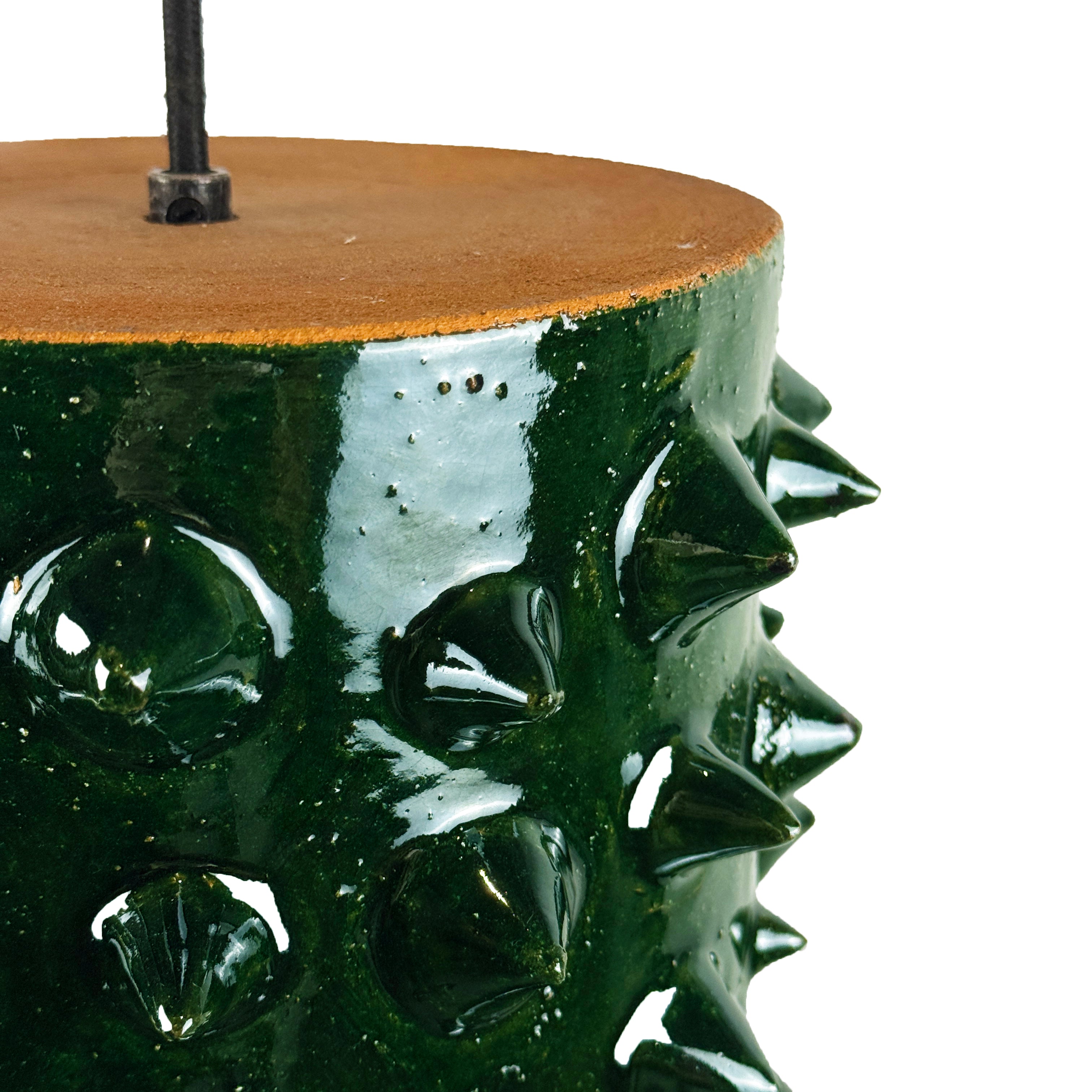


Pochote Green Clay Lamp
Inspired by the armored trunk of the pochote tree, this handmade clay lamp pairs exaggerated conical thorns with the deep green glaze of Santa María Atzompa, Oaxaca. Its sculptural form brings a little of the tree's wild presence indoors, turning a fierce silhouette into a source of light.
The design began with an encounter at Oaxaca's Jardín Etnobotánico, where founding director Alejandro de Ávila described a theory linking the pochote's formidable thorns to the giant herbivores that once roamed the Americas. The animals disappeared; the tree kept its armor. That enduring form became the starting point for a lamp rooted in Oaxaca's landscape and clay traditions.
Dimensions
10" D x 12" H
About Green Clay from Oaxaca
The beauty of Oaxaca's green-glazed clay lies in the depth of its hue, a rich, lustrous green that gathers in the contours of each piece. Handmade in Santa María Atzompa from a local clay body, our pieces are finished with the same nontoxic, food-safe green glaze we use on our cookware. Subtle variations in color and finish reflect the handwork behind every piece, giving this traditional material a character that is never quite the same twice.
About Oaxaca
I arrived in Oaxaca around 2000, and it stole my heart. I have lived and worked there ever since, building Oax-i-fornia, a project that brings artisans, designers, and students together while learning from the knowledge already held within Oaxaca's communities. Set in the mountains of southern Mexico, Oaxaca remained relatively isolated from the country's industrial development well into the twentieth century. The Pan American Highway reached the city in the 1940s, opening it more fully to tourism and the rest of Mexico. Long before that, its fertility and wealth were recognized by the Spanish Crown, which granted Hernán Cortés the title Marquis of the Valley of Oaxaca in 1529. Conquest transformed the region, but it did not erase its extraordinary diversity. Across Oaxaca, Indigenous communities retained languages, forms of local government, communal relationships to the land, and highly specific ways of making the objects required for daily life. This is why craft in Oaxaca is not simply a decorative tradition. In many communities, it remains part of the working infrastructure of the home. Metates still grind corn; molcajetes prepare sauces; comales cook tortillas much as they have for generations. Traditions are not static. Black clay, once used primarily for practical water vessels, became increasingly polished and ornamental during the twentieth century. New forms, markets, and collaborations continue to change what is made. Yet the knowledge behind these objects remains intensely local, rooted in particular soils, plants, tools, foods, and communities. Even today, Oaxaca continues to shape how I understand design, not as something imposed upon an object, but as knowledge accumulated through use.
About Handmade Pieces
Crafted by hand using techniques passed down through generations of master artisans. Variations in color, texture, and finish are inherent to the process; each piece is, by nature, one of a kind.
Choose options